
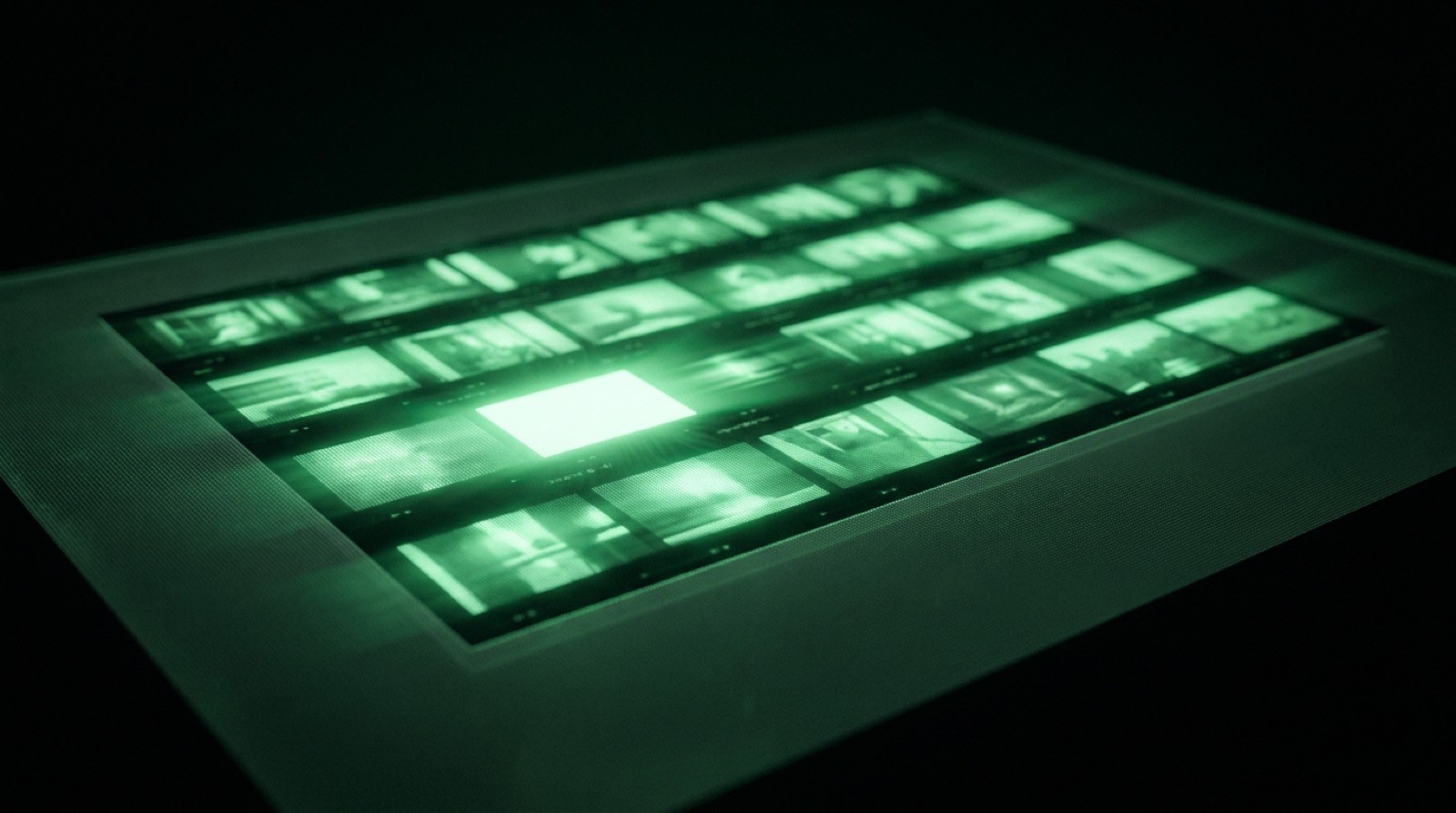
Every image on this site is generated from one file. Here's the manifest, the pipeline, and the mistake I made on the first pass.
Every website gives itself away with its images. Stock everyone has already seen, or the current default: a glowing gradient blob, an "AI brain", a circuit board. You scroll past without registering a thing.
I wanted the opposite. Every image here should look like it came from one studio, in one house style, in the Pixl green. And I wanted to change all of them by editing text, not by opening a design tool.
So the images here are not picked. They are generated, from one file.
One file, one signature
illustrations/manifest.mjs. One spec per image, nothing else:
{
  id: "the-baton-pattern",
  kind: "blog",          // blog | product
  accent: "#30CB77",     // the one light colour
  aspect: "16:9",
  archetype: "hands+object",
  concept:
    "Extreme close-up of two hands at the moment of a relay handoff, " +
    "passing a small glowing green baton-token between them.",
  tags: ["hands", "relay", "handoff", "token", "green"],
}
Above the specs sits one shared STYLE_BASE, appended to every prompt: near-black background, one accent light with soft bloom, film grain, a faint pixel grid. The concept changes per image. The signature never does.
That is the whole trick. The subject varies so the set has range. The treatment stays constant so it reads as one brand.
The pipeline is one call
`generate.mjs` walks the manifest and sends each prompt to OpenRouter with the image modality on:
const res = await fetch("https://openrouter.ai/api/v1/chat/completions", {
  method: "POST",
  headers: { Authorization: `Bearer ${KEY}`, "Content-Type": "application/json" },
  body: JSON.stringify({
    model: "google/gemini-3-pro-image",
    modalities: ["image", "text"],
    messages: [{ role: "user", content: buildPrompt(spec) }],
  }),
});
const url = data.choices[0].message.images[0].image_url.url; // data: URI
The image comes back as a base64 data URI. The script decodes it and writes public/illustrations/<kind>/<id>.jpg. A fallback model kicks in if the primary returns nothing. Read a spec, ask for an image, save it.
One command regenerates everything: node illustrations/generate.mjs.
The mistake
The honest part, because this is build-in-public and the first version was wrong.
My initial STYLE_BASE ended with a wall of bans: abstract only, no humans, no robots, no brains, no circuit-board clichés. I was so busy dodging the AI-slop defaults that I banned every recognizable subject along with them.
The result: sixteen images that were all on-brand and completely interchangeable. Green light trails. Green geometric modules. Green nodes on a grid. Every post looked like the same screensaver. On-brand, and forgettable.
The lesson landed when I looked at what actually stops people in 2026. Not AI-polished abstraction. Human, editorial, recognizable subjects. A face. A pair of hands. An object you know. My all-abstract set was exactly the homogenized look people have learned to scroll past.
So I deleted the ban and gave each post one archetype: a portrait, a pair of hands, an object, a room. A real subject, under the same signature. Same file, same pipeline. I changed the words in the concept field and ran the command again. Sixteen forgettable blobs became sixteen images you can describe to someone.
Why bother
The alternative is buying stock, or hand-making forty images and hand-making them again the day the brand green shifts.
With a manifest, the visual system is text. Diffable, reviewable, regenerable. A new post needs one spec and one line in its front matter: image: "/illustrations/blog/…jpg". That path fills the index card, the hero, the OG card, and the structured data. A palette change is a find-and-replace.
The image at the top of this post came out of the same file as everything else here. Which means the day I hate the Pixl green, I get to ruin all of it at once.
That is the point. The images are not the product. The system that makes them is.